Page Not Found
Page not found. Your pixels are in another canvas.

A list of all the posts and pages found on the site. For you robots out there is an XML version available for digesting as well.
Page not found. Your pixels are in another canvas.
About me
This is a page not in th emain menu
Published:
Published:
Published:
Published:
Published:
Published:
Our group is currently preparing to head to Washington D.C. for the annual American Geophysical Union (AGU) conference.
Published:
Radial basis functions (RBFs) have been used for adaptive system control in multiple water resource systems publications. They show up regularly in blog posts, such as here, and here, and others. However, they have never gotten their own detailed post.
Published:
In this post, I provide an argument for using Bayesian Additive Regression Trees (BART) in scenario discovery contexts, highlighting the strengths of the BART model compared to other models used in the literature. I give a very quick introduction to the BART model formulation. Finally, I demonstrate the benefit of using BART for scenario discovery (AKA factor mapping) compared to deterministic Gradient Boosted Tree methods using the Shallow Lake Problem.
Published:
Last week I had the chance to travel to St. Paul, Minnesota, for the WaterSciCon conference hosted by AGU and CUAHSI. In this post, I give some of my own reflections on the core themes from the conference and share links and resources that were highlighted during the sessions.
Published:
This post was inspired by the Sankey diagram in Figure 1 of this pre-print led by Dave Gold: “Exploring the Spatially Compounding Multi-sectoral Drought Vulnerabilities in Colorado’s West Slope River Basins” (Gold, Reed & Gupta, In Review) which features a Sankey diagram of flow contributions to Lake Powell. I like the figure, and thought I’d make an effort to produce similar diagrams using USGS gauge data.
Published:
Fans of this blog will know that uncertainty is often a focus for our group. When approaching uncertainty, Bayesian methods might be of interest since they explicitly provide uncertainty estimates during the modeling process.
Published:
In 1962 a group of economists, engineers and political scientists who were involved in the Harvard Water Program published “Design of Water Resource Systems”. In chapter 12 of the book, Thomas and Fiering present the following statistical model which was one of the first, if not the first, formal application of stochastic modelling for synthetic streamflow generation and water resource systems evaluation.
Published:
Just over 12 years ago, on January 9th 2012, the first WaterProgramming post was published. It was written by Joe Kasprzyk who is now an Associate Professor at CU Boulder, but at the time was a graduate student in the Reed Research Group. The post reads, in it’s entirety:
Welcome!
“This blog shares tips for writing programs and running jobs associated with using multiobjective evolutionary algorithms (MOEAs) for water resources engineering. It will be informal, with posts on a number of topics by a number of folks.”
Published:
Previously, in Part 1 I used a very simple reservoir operations scenario to demonstrate some linear programming (LP) concepts.
Published:
Originally published on the WaterProgramming blog. The formulation below reflects the revised version of the post, which optimizes both releases and storage over multiple timesteps. See Part 2 for the Python implementation using Pyomo.
Published:
Over the past several months, I have been working with data from the US Geological Survey’s (USGS) National Hydrologic Model (NHM), a valuable resource that required some time to become familiar with. The goal of this post is to provide an overview of the NHM, incorporating as many links as possible, with the hope of encouraging others to utilize these resources and serving as a springboard for further investigation.
Published:
In their 2013 publication, Pederson et al. try to answer the question posed by the title: Is an Epic Pluvial Masking the Water Insecurity of the Greater New York City Region?
Published:
Interactive mapping and data visualization provide data scientists and researchers with a unique opportunity to explore and analyze spatial data, and to share their work with stakeholders in a more engaging and accessible way.
Published:
The start of a new year is a good (albeit, relatively arbitrary) time to reassess aspects of your workflow.
Published:
Predicting streamflow at ungauged locations is a classic problem in hydrology which has motivated significant research over the last several decades (Hrachowitz et al., 2013).
Published:
Over the last year, being in the Reed Research Group, I have been exposed to new ideas more rapidly than I can manage. During this period, I was filling my laptop storage with countless .docx, .pdf, .txt, .html files semi-sporadically stored across different cloud and local storages.
Published:
This tutorial highlights the HyRiver software stack for Python, which is a very powerful tool for acquiring large sets of data from various web services.
Published:
This is the second post in a training series, studying decision making under deep uncertainty within the context of a complex harvested predator-prey fishery.
Published in Hydrological Processes, 2022
Here, we study how historic wetland drainage permanently changed soil properties in the Great Dismal Swamp.
Recommended citation: Word, C. S., McLaughlin, D. L., Strahm, B. D., Stewart, R. D., Varner, J. M., Wurster, F. C., Amestoy, T. J., & Link, N. T. (2022). "Peatland drainage alters soil structure and water retention properties: Implications for ecosystem function and management." Hydrological Processes, 36(3), e14533. https://doi.org/10.1002/hyp.14533
Published in Environmental Modelling & Software, 2024
We introduce Pywr-DRB, an open-source water management simulation model of the Delaware River Basin that represents reservoir operations, New York City diversions, and the Flexible Flow Management Program, and use it to evaluate water availability and drought risk under multiple streamflow datasets.
Recommended citation: Hamilton, A. L., Amestoy, T. J., & Reed, P. M. (2024). "Pywr-DRB: An open-source Python model for water availability and drought risk assessment in the Delaware River Basin." Environmental Modelling & Software, 181, 106185. https://doi.org/10.1016/j.envsoft.2024.106185
Published in Environmental Modelling & Software, 2026
First-author paper presenting an integrated framework for stress-testing modern water management policies against historical droughts. A 1,000-member probabilistic reconstruction of daily Delaware River Basin streamflows (1945–2023) is generated by combining the National Hydrologic Model, a probabilistic flow-duration-curve prediction in ungauged basins method, and Bayesian bias correction, then used to drive Pywr-DRB.
Recommended citation: Amestoy, T. J., Hamilton, A. L., & Reed, P. M. (2026). "Integrated river basin assessment framework combining probabilistic streamflow reconstruction, Bayesian bias correction, and drought storyline analysis." Environmental Modelling & Software, 195, 106756. https://doi.org/10.1016/j.envsoft.2025.106756
Published in Journal of Water Resources Planning and Management, 2026
Co-authored study examining how water utilities can jointly manage water supply reliability and financial risk when planning under deep uncertainty.
Recommended citation: Petagna, C., Li, D., Gorelick, D. E., Gold, D. F., Amestoy, T., Lau, L., Asefa, T., Wang, H., Svrdlin, S., Reed, P. M., & Characklis, G. W. (2026). "Balancing Supply and Financial Risks in Water Utility Decision Making under Uncertainty." Journal of Water Resources Planning and Management, 152(4), 04026006. https://doi.org/10.1061/JWRMD5.WRENG-7164
Published:
The 2019 Peace Engineering Consortium was held at the University of New Mexico in partnership with the Global Engineering Deans Council, Sandia National Laboratory, Los Alamos National Laboratory, and Stanford’s Peace Innovation Lab.
Published:
Talk given in the Integrated Hydro-Terrestrial Modeling (IHTM) session at the inaugural WaterSciCon, co-hosted by AGU and CUAHSI. Co-authors: Andrew L. Hamilton and Patrick M. Reed.
Published:
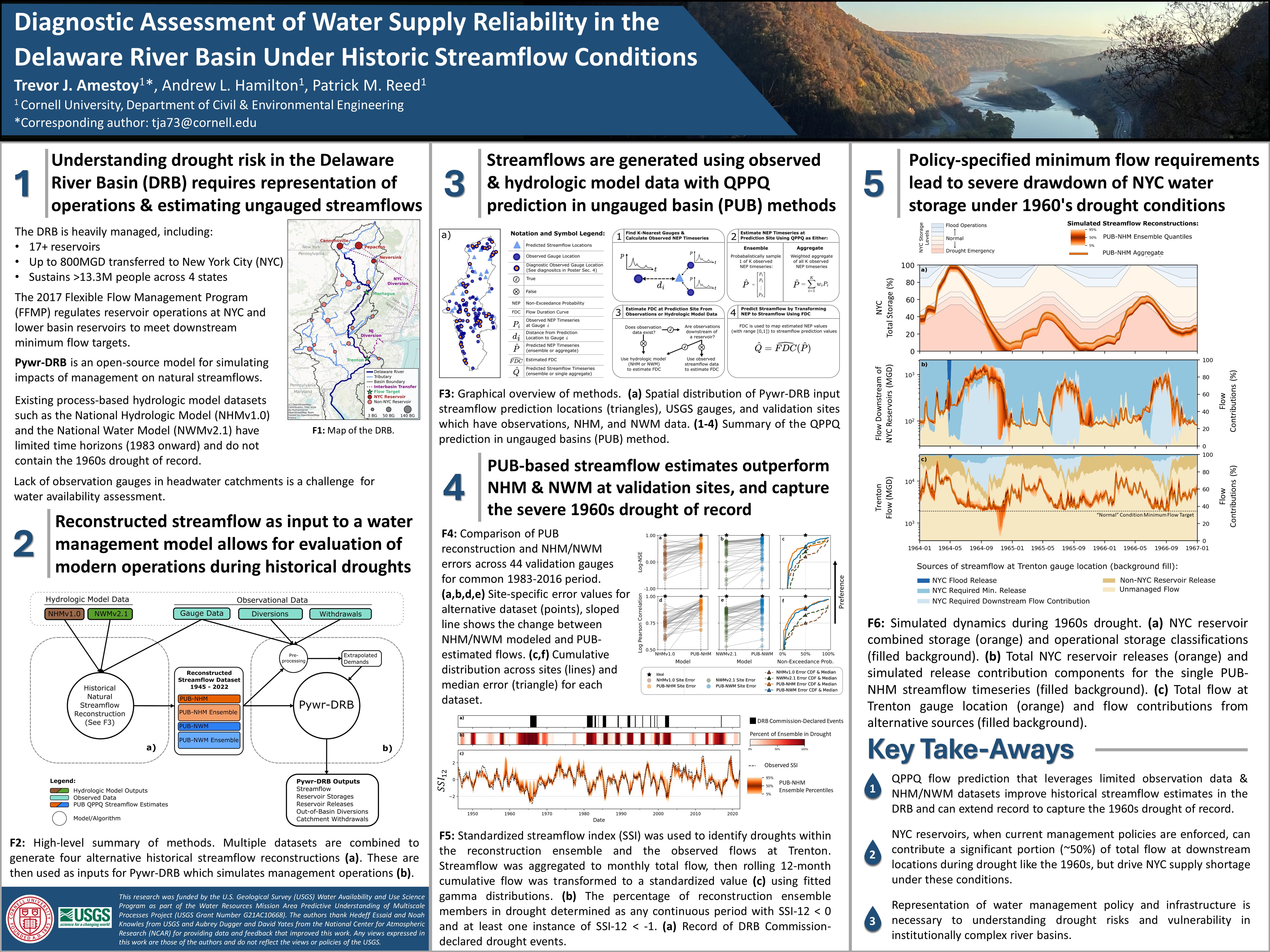
Poster GC31V-0105 presented in the Multisector Dynamics: Science and Modeling for Societal Transformation session. Co-authors: Andrew L. Hamilton and Patrick M. Reed.
Published:
Oral presentation at the AGU Fall Meeting 2025. Co-author: Patrick M. Reed.
Graduate Teaching Assistant, Cornell University, School of Civil and Environmental Engineering, 2023
Graduate Teaching Assistant for CEE 5980 (Fall 2023), a graduate course on decision framing and analytics covering decision trees, risk profiles, value of information, risk attitudes and utility, and multi-objective decision making.
Graduate Teaching Assistant, Cornell University, Engineering Management Program, 2024
Graduate Teaching Assistant for ENMGT 5920 (Spring 2024), a project-based course in the Engineering Management program covering the product management lifecycle through team “sprints”, case studies, and guest lectures from industry product managers.